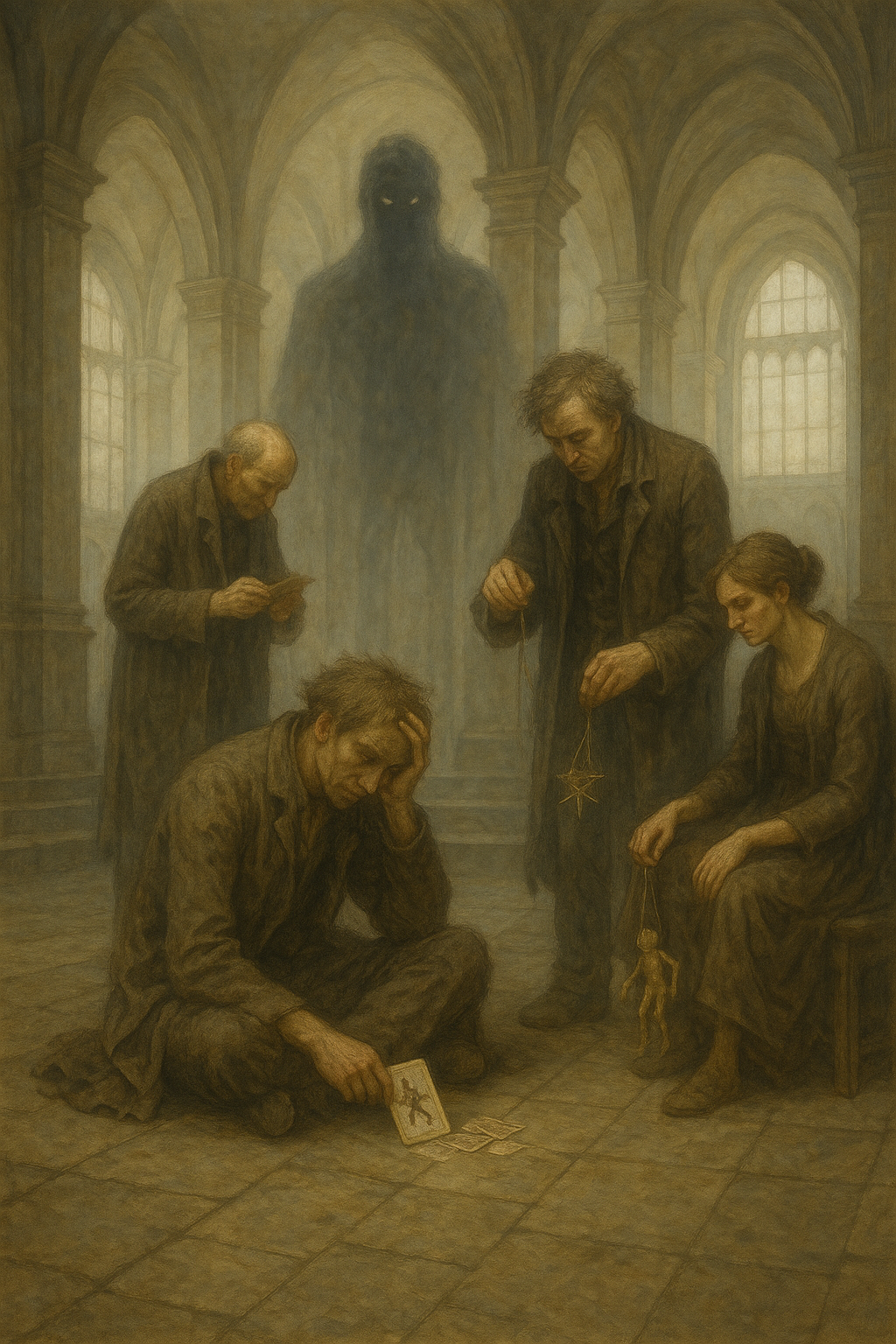
Hilbert’s Dream
Newton basically booted the universe and forgot to log out. Gravity ran smooth, planets orbiting like clock widgets. Everyone freaked out: “Yo, math is the vibe of reality.” So Enlightenment brain said, Cool, let’s worship equations now. Laplace shows up, main-character energy, whispering, “I can automate the divine.” He wanted full admin rights on existence. If you knew all the variables, you could replay creation on demand. Future, past, delete history, control-Z the Big Bang. Peak overconfidence. Peak French Enlightenment. They called it determinism; in the rear-view mirror, it was just anxiety with good PR.
The nineteenth century hits — industry, optimism, and coal. Everything’s fine, apparently. Then Poincaré face-plants into chaos. He’s doing orbital math and suddenly the system says no can do. Three bodies start waltzing off-script, and the prize committee still gives him a medal for discovering anxiety 2.0. Determinism caught feelings. Turns out you can have perfect rules and still no clue what’s next. Story of my life, no cap. Every tiny change, new timeline. Laplace’s Demon starts lagging. Committee-written divine.sh develops runtime errors. “God is dead,” Nietzsche said. “Long live the God,” replied Silicon Valley, firing up another government-subsidy-fueled data center.
Hilbert spawns later, chalk in hand, high on rigor, the hat a lowkey flex, tilted jaunty-for-the-bit. He puffs, “No stress, fam, we’ll just patch the universe with logic.” The dream? Total consistency. All of math, clean and self-contained. Then Gödel slides in, pale, twitchy, eyes full of recursion — man looked like he hadn’t touched a carb since Euclid — and drops the ultimate spoiler: “You can’t prove everything without breaking it.” Then Gödel slides in, pale, twitchy, eyes full of recursion—built like a theorem that forgot to eat—and drops the ultimate spoiler: “You can’t prove everything without breaking it.” Bro wrote a proof that gave reality imposter syndrome and Russell a need for an enema. Hilbert tried to recover. Didn’t. Kernel panic. System crashed. Rebooted to existential despair. Now the Demon’s in a corner running diagnostics, muttering “undefined behavior” while God’s ghost watches through a cracked monitor.
Physics wasn’t better. Quantum mechanics pulled up like: “Hey, we roll dice now.” Einstein said, “God doesn’t play.” Universe said, “Try me.” Everything blurred — observation changed the observed, cats lived and died simultaneously, and measurement became a jump scare. Heisenberg shrugged. Schrödinger memed it. The lab turned into a therapy session with better funding. Predictability died offscreen. We started calling probability “truth,” and uncertainty “a feature.”
It’s the 21st century, and the Demon’s back in session — full-blown, cloud-hosted, subscription-based. Laplace’s descendants code omniscience in Python notebooks, sacrificing terawatts to the altar of data. Damn the torpedoes, bill the client. We still think prediction equals power, even as the graphs curve into nonsense. Every phone hums the new catechism: recommend, optimize, consume. The feed knows what you’ll want before you get lonely enough to want it. The algorithm doesn’t judge. It doesn’t care. It just scrolls. Forever. Divinity didn’t die; He pivoted to SaaS.
Sometimes I think Poincaré won. Sometimes Gödel. Mostly I think nobody did. Kierkegaard — he may have been on the right track, laughing the last laugh. We’ve got theories like empty energy drinks — still buzzing, no flavor. Academia cosplays as certainty while chaos farms engagement. Everyone’s publishing heat death under peer review. The glow of rationality still lights the ruins, fluorescent and a little too confident. We call it progress. It feels like lag. Maybe freedom was never transcendence — just a debugging session with mood lighting. Maybe Laplace’s Demon didn’t fail; he got bored. After all, when you predict everything, surprise dies, and with it, meaning.
“Automate Divinity,” Laplace said.
The system whispered back: Already done.
God is dead; long live the God — the one made of APIs and apathy, the one that doesn’t care but still runs the numbers, like a crooked broker who can’t stop trading.
We keep calculating. We keep doomscrolling. We keep pretending knowledge is the same as understanding. Somewhere in the server racks of eternity, the Demon keeps refreshing, calling foo(), bar(), and ? = (?x.x x)(?x.x x) in an endless loop, watching the stack overflow into silence. FUBAR, but elegant.